TSE adopts a 30-second random close from October 2027 and liquidity-based tick sizes from March 2027
Tokyo's rule revisions move the afternoon closing auction to a random time between 3:29:30pm and 3:30pm JST from 12 October 2027 or later. From 1 March 2027, each stock's tick size table will be set by its spread-to-tick ratio instead of its index membership.
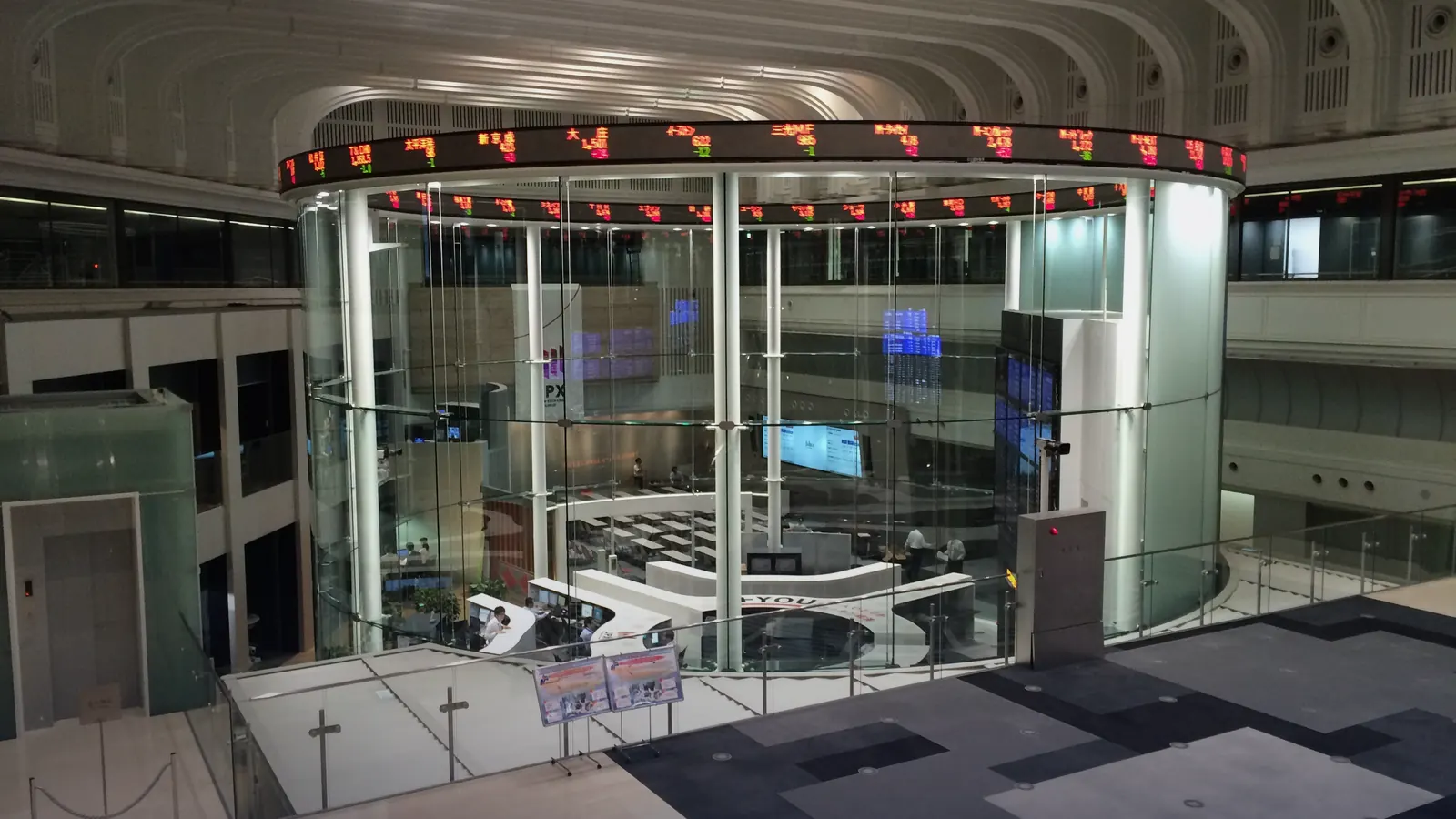
On 6 August 2026, Tokyo Stock Exchange (TSE) published revisions to its Business Regulations and related rules. They implement three proposals from its Working Group on Trading Rules, whose report came out on 22 April. The rule outline covers:
- a random closing time for the afternoon closing auction, from 12 October 2027
- a new method for assigning tick sizes, from 1 March 2027
- revised access fees for auction trading, from 1 March 2027
TSE reserves the right to delay the random close past 12 October 2027 if it judges launch on that date inappropriate because of trading-system problems or other unavoidable reasons.
Random closing
TSE introduced its closing auction session in November 2024. It includes a pre-closing session from 3:25pm JST, with the afternoon close Itayose (TSE’s call-auction matching) at 3:30pm. Under the revised Business Regulations:
- When. The afternoon close Itayose runs at a random time between 3:29:30pm and 3:30:00pm JST each business day.
- Which stocks. The time is the same for every issue with a closing auction.
- Order types. The April report places no restrictions on order types. New orders, price and size modifications and cancellations stay allowed until the Itayose runs.
- Indicative prices. TSE will publish indicative equilibrium prices and volumes during pre-closing. It plans to do the same for a set period before the morning and afternoon opening auctions.
Why TSE chose 30 seconds
The working group said it had “not identified any malicious gaming activities” around the close, though some members argued for anti-gaming measures as prevention. It weighed this against concerns that a random close would make arbitrage trading less convenient. TSE chose a 30-second window, rather than a longer one, to limit the effect on arbitrage.
Stakeholders from Europe, the US and Hong Kong told the group that they had seen no notable impact on arbitrage in markets that already use a random close. TSE’s reference materials cite the London Stock Exchange and Euronext Paris as examples. On those venues, orders accumulated earlier after a random close was introduced.
TSE’s own data, covering 5 November 2024 to 30 June 2025, shows the ratio of modified and cancelled orders tending to fall after 3:29pm, with indicative prices converging towards the closing price. TSE says the convergence is particularly pronounced on index rebalancing days.
Liquidity-based tick sizes
Since January 2014, TSE has assigned tick sizes by index classification, starting with finer ticks for TOPIX 100 constituents. It optimised ticks further for TOPIX Mid400 constituents in June 2023. The working group noted stakeholder complaints that index membership is a poor guide to liquidity, leaving some stocks with ticks that are too large and others with ticks that are too small. From 1 March 2027, each stock’s table will depend on its spread-to-tick ratio (STR) instead: the nominal spread divided by the tick size.
The four new tables are:
- Table A, “Active”: ultra-high liquidity. ETFs and ETNs use Table A as a rule, regardless of STR.
- Table B, “Basic”: high liquidity
- Table C, “Calm”: medium liquidity. New direct listings start on Table C as a rule.
- Table O, “One Unit”: stocks whose trading unit is one share
The annual review
Every August, TSE will review each stock’s table using its median STR over the nine months from August to April:
- Median STR below 1.5: the stock moves one table finer, from C to B or from B to A
- Median STR from 1.5 to 5.0: no change
- Median STR above 5.0: the stock moves one table coarser, from A to B or from B to C
TSE plans to announce table changes two months before they take effect. It is also considering publishing each stock’s STR regularly.
What TSE found and expects
TSE’s reference materials found that tick sizes are poorly matched to liquidity under the current system:
- TOPIX 100. 52.0% of constituents have an STR below 1.5. TSE says that for ultra-high-liquidity issues, even the current TOPIX 500 tick table is too coarse.
- TOPIX Mid400. 80.7% of constituents have an STR in the 1.5 to 5.0 range TSE considers appropriate, but 11.1% are above 5.0.
Stakeholder views in the report were mixed. Some welcomed coarser ticks for low-liquidity stocks as a way to improve market depth. Others questioned whether the change justified its system costs and warned against frequent table changes. TSE kept to one review a year.
TSE’s market-wide estimate in the April report is a 20% to 40% increase in order volume and an 8% to 16% increase in execution volume. The report says the estimates are based on historical data and “certain assumptions”.
Why it matters
Analysis.
- Order timing at the close. With a 30-second random window, closing-auction orders entered after 3:29:30pm JST may miss the auction. Brokers’ closing algorithms and index funds’ rebalancing procedures will need to submit and adjust orders earlier.
- Tick sizes become a variable. Under the current regime, a stock’s tick changes when its index membership changes. Under STR, it can change at each annual review. Order management systems, pre-trade price checks, market data displays and backtests have to treat tick tables as data that changes every year, not fixed reference data.
- More messages. TSE’s own estimate of 20% to 40% more orders bears directly on capacity planning for brokers, vendors and TSE’s trading system.
- Convergence with other venues. Stakeholders gave the working group two views on tick sizes across venues. One said tick-size differences across venues add complexity and cost and should be standardised. The other said investors already route to proprietary trading systems (PTSs) and dark pools with smaller ticks, which limits the benefit of finer TSE ticks. How the PTS operators respond will shape how smart order routers handle Japanese stocks.
What we are watching
- The tick-size table assigned to each stock for the March 2027 switch.
- Whether TSE starts publishing STRs regularly, and whether the PTS operators match the new tables.
Added 1 Nov 2026 to the Market Structure section; dated to the event, not published at the time.
Sources
- Revisions to Business Regulations and Other Rules in Connection With Revisions to Trading Rules to Further Enhance the Functionality of the Cash Equity Market (Outline), Tokyo Stock Exchange, 6 Aug 2026
- Report From the Working Group on Trading Rules (news release, updated with rule revisions), Japan Exchange Group, 6 Aug 2026
- Working Group on Trading Rules: Reference Materials (revised 6 Aug 2026), Tokyo Stock Exchange, 6 Aug 2026
- Report From the Working Group on Trading Rules, Tokyo Stock Exchange, 22 Apr 2026
- Report From the Working Group on Trading Rules (Overview), Tokyo Stock Exchange, 22 Apr 2026
Sources
- Revisions to Business Regulations and Other Rules in Connection With Revisions to Trading Rules to Further Enhance the Functionality of the Cash Equity Market (Outline) — Japan Exchange Group / Tokyo Stock Exchange, 6 Aug 2026
- Report From the Working Group on Trading Rules (news release, updated with rule revisions) — Japan Exchange Group, 6 Aug 2026
- Working Group on Trading Rules: Reference Materials (revised 6 Aug 2026) — Tokyo Stock Exchange, 6 Aug 2026
- Report From the Working Group on Trading Rules — Tokyo Stock Exchange, 22 Apr 2026
- Report From the Working Group on Trading Rules (Overview) — Tokyo Stock Exchange, 22 Apr 2026
News and information only, not investment advice. See our disclaimer.
Spotted an error? Email [email protected]. See our editorial standards, including how we use AI and handle corrections.